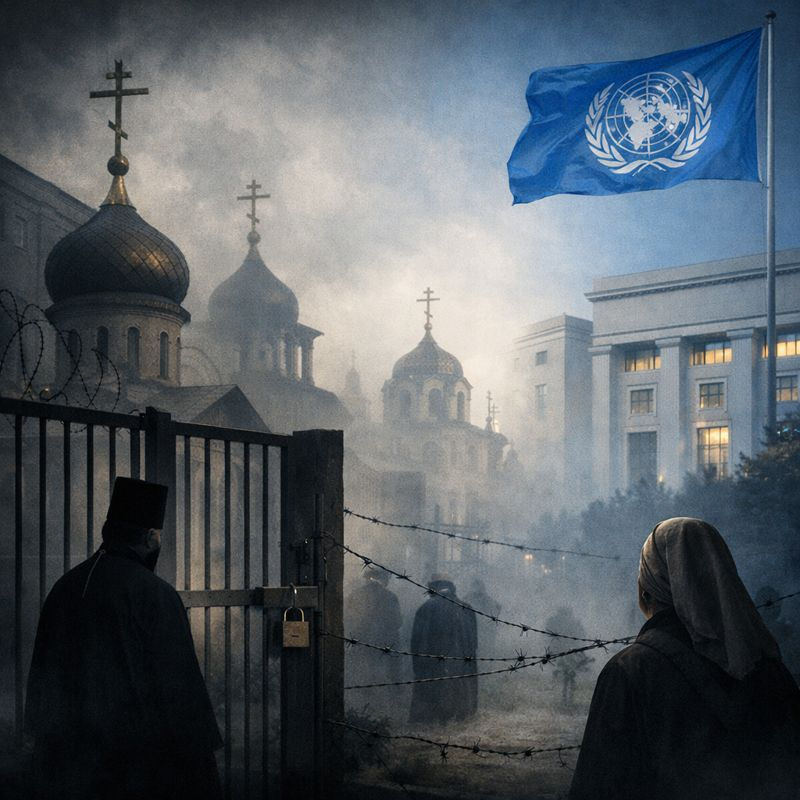
The Supreme Court of Estonia Declines to Include JPTi’s Amicus Curiae Submission in the Official Case File
- Apr 1
- 4 min read
Updated: Apr 2

Geneva, 1 April 2026 — On 8 March 2026, Justice pour Tous Internationale (JPTi) formally submitted an amicus curiae memorandum to the Supreme Court of the Republic of Estonia (Riigikohus) in constitutional review case No. 5-25-49, following the Court’s confirmation on 26 February 2026 that JPTi could provide its opinion in the proceedings. The submission was prepared by Emeritus Professor Douwe Korff, was filed in English, and was accompanied by a full Estonian translation in order to facilitate the Court’s review.
The amicus curiae memorandum addresses the compatibility of the contested amendments to the Churches and Congregations Act (Kirikute ja koguduste seadus, KiKoS) with Estonia’s obligations under Article 9 of the European Convention on Human Rights and Article 18 of the International Covenant on Civil and Political Rights. It examines, inter alia, the absolute protection of the forum internum, collective religious autonomy, proportionality, legal certainty, discrimination, and the impermissibility of coercive interference with canonical and spiritual ties. The memorandum also expressly supports the position of President Alar Karis in referring the amendments for constitutional review, on the ground that their apparent incompatibility with Estonia’s ratified international human rights obligations gives rise to serious constitutional concerns. Full text of the amicus curiae can be downloaded here:
In Estonian:
In English:
On 12 March 2026, JPTi was informed by the Secretariat of the Supreme Court that its letter of 8 March 2026 and the attached amicus materials had been received and forwarded to the Supreme Court sitting in plenary formation (üldkogu). JPTi was further informed that the plenary had not yet decided whether the opinion would be taken into case No. 5-25-49. In earlier correspondence dated 26 February 2026, the Court had likewise stated that, although JPTi could submit its opinion, the question whether that submission would be taken into the case would be decided by the plenary in the course of resolving the matter.
On 31 March 2026, JPTi was informed that its amicus curiae submission would not be placed on the official case file. JPTi notes that this refusal came after the submission had been accepted for consideration for filing, confirmed as received, and forwarded to the Supreme Court’s plenary formation for consideration.
In JPTi’s assessment, this sequence of events raises ambiguity and legitimate doubts as to whether independent international human rights analysis under Article 9 of the European Convention on Human Rights and Article 18 of the International Covenant on Civil and Political Rights will be given meaningful weight in the proceedings. Without prejudging the final judgment of the Supreme Court, the refusal to place the amicus on the official case file raises serious concern regarding the openness of constitutional adjudication to expert international legal submissions in a case involving fundamental rights, religious autonomy, legal certainty, and the rule of law.
On 16 March 2026, during the OSCE Supplementary Human Dimension Meeting in Vienna, JPTi publicly commended President Karis for acting as a constitutional safeguard by refusing promulgation of the amendments and referring them to the Supreme Court for constitutional review. During that intervention, JPTi also urged the Government of Estonia, and in particular the Ministry of the Interior, under which the Estonian Internal Security Service (KAPO) operates, to withdraw the contested amendments and to engage in meaningful dialogue with affected religious communities.
JPTi further reiterates its call upon the Chancellor of Justice of Estonia, in her dual capacity as constitutional guardian and National Human Rights Institution accredited with “A status” under the Paris Principles, to ensure that her public advocacy and legal analysis explicitly and consistently reflect Estonia’s binding obligations under Article 9 of the European Convention on Human Rights and Article 18 of the International Covenant on Civil and Political Rights. JPTi also calls upon the Chancellor to address adequately the concerns expressed in the United Nations Special Procedures communication JAL EST 2/2025 of 6 August 2025 and in the subsequent UN experts’ press release of 15 December 2025.
On 15 December 2025, UN experts expressed concern that recent legislative and administrative measures affecting the Estonian Orthodox Christian Church may amount to impermissible restrictions on freedom of religion or belief and minority rights. They stressed that canonical identity, ecclesiastical hierarchy, and spiritual allegiance are integral components of freedom of religion and are fully protected under international law. They further recalled that national security is not a permissible ground for restricting freedom of religion or belief under Article 18 of the ICCPR and Article 9 of the ECHR, welcomed President Karis’s decision to refer the amendments to the Supreme Court, and called on the Estonian Government to halt administrative and judicial actions directed at the Church pending the outcome of constitutional review and to launch inclusive consultations with affected communities.
JPTi also announces further follow-up action with the Personal Representative of the OSCE Chairperson-in-Office on Combating Intolerance and Discrimination against Christians and Members of Other Religions, as well as with the United States Commission on International Religious Freedom (USCIRF). On 17 February 2026, JPTi transmitted a formal submission to USCIRF requesting preventive monitoring of the situation in Estonia and consideration of Special Watch List designation. On 19 February 2026, JPTi addressed the OSCE Personal Representative in order to seek engagement and dialogue-oriented support regarding the situation affecting the Estonian Christian Orthodox Church. As a further step, JPTi will now share this press release, its amicus curiae memorandum, and the information about Supreme Court’s refusal to place that memorandum on the official case file with both USCIRF and the OSCE Personal Representative.
JPTi considers that this follow-up is necessary because the refusal to place the amicus on the official case file, notwithstanding the Court’s earlier acceptance of the submission and its transmission to the plenary, reinforces the need for continued preventive international attention. In JPTi’s view, the present stage of the proceedings requires careful scrutiny by international actors precisely because it raises legitimate concern as to the direction the case may now take and whether Estonia’s binding human rights obligations will be fully and expressly reflected in the final constitutional assessment.
Justice pour Tous Internationale remains committed to constructive engagement with Estonian authorities, European institutions, OSCE mechanisms, USCIRF, and United Nations human rights mechanisms in defence of freedom of religion or belief, the rule of law, and democratic accountability. JPTi will continue to advocate for full compliance with international human rights standards and for the protection of all religious communities against coercive, discriminatory, or security-based interference with their lawful existence, governance, and canonical identity.